

This post contains affiliate links. If you buy through them, we may earn a small commission at no extra cost to you — it keeps DecorHackss running. Thank you!
How High to Hang Curtains? The Short Answer
If your curtains have ever looked “almost right but not quite,” the problem is almost never the fabric — it is the height. Knowing how high to hang curtains is the single cheapest upgrade in decorating: it costs nothing but a tape measure, and it can make a small window look grand and a low ceiling feel a foot taller.
Here is the short answer. Mount the rod 4 to 6 inches above the window frame — or halfway between the top of the frame and the ceiling — extend it 8 to 12 inches beyond the frame on each side, and let the panels end right at the floor.
That is the whole formula. The rest of this guide explains why each number works, how to measure for it, and the five mistakes that quietly ruin the look.
Designers say curtain rods are one of the most common hanging mistakes they see — The Spruce asked two designers about the items people hang at the wrong height, and drapery was the first offender on the list. Let us fix yours today.
The Simple Formula for How High to Hang Curtains
Tape this to the inside of a kitchen cupboard:
- Height: rod 4–6 inches above the frame, or halfway to the ceiling
- Width: rod extends 8–12 inches past the frame on both sides
- Length: panels finish at the floor — a gentle “kiss,” not a hover
Three numbers — every well-dressed window follows them. Now the details.
Rule 1: Hang the Rod 4–6 Inches Above the Frame
The biggest mistake in curtain hanging is mounting the rod directly on top of the window frame, or just an inch above it. It visually chops the wall in half and makes the window — and the whole room — feel shorter than it is.
Instead, mount the rod 4 to 6 inches above the frame. If you have a generous gap between the frame and the ceiling (more than about 12 inches), use the halfway rule: place the rod halfway between the top of the frame and the ceiling. The eye reads the curtain as starting near the ceiling, so the wall feels taller and the window looks like it stretches upward.
One exception: if crown molding runs close to the ceiling, hang the rod just below the molding so the brackets sit on flat wall.
Rule 2: Go Wider — 8–12 Inches Beyond the Frame
Height is only half the trick. A rod that is exactly the width of the window forces the open curtains to cover the edges of the glass, blocking light and making the window look narrow.
Extend the rod 8 to 12 inches beyond the frame on each side — so the full rod is 16 to 24 inches wider than the window itself. When the curtains are open, the panels rest mostly against the wall, the whole pane of glass is exposed, and the window reads much bigger than it really is.
This is the same high-and-wide styling we used all through our Christmas living room decor ideas — it is why those windows look so generous in photos.
Rule 3: Get the Length Right — Sill, Apron, Kiss or Puddle
Curtain length has four classic finishes. Three of them have a place; only one belongs in most living rooms and bedrooms.
- Sill length: panels end right at the windowsill. Practical above radiators, kitchen sinks and in kids’ rooms — but it can look abrupt in a formal room.
- Apron length: panels end about 4 inches below the sill. A traditional, tidy finish that works well for café-style curtains.
- Floor kiss: panels end about half an inch above the floor, or just graze it. This is the designer default — clean, tailored, and easy to vacuum under. This is the length we recommend for almost every room.
- Slight puddle: panels break 1 to 3 inches onto the floor. Romantic and luxurious with linen or velvet, but it collects dust and does not suit busy households or homes with pets.
Whatever you choose, the one finish to avoid is the accidental in-between: panels that hover 2 to 4 inches above the floor. That gap is never a style choice — it just looks like the curtains shrank in the wash.

Does Ceiling Height Change the Rules? 8 ft vs 9 ft+
The formula stays the same, but your ceiling decides which half of it does the heavy lifting.
Standard 8-foot ceilings: You probably have 6 to 12 inches of wall between the frame and the ceiling. Split the difference — the halfway rule lands your rod around 4 to 6 inches above the frame, which is exactly where it should be. Every inch of height matters in these rooms, so do not give any away.
Ceilings of 9 feet and higher: You have room to be dramatic. Hang the rod 6 to 8 inches above the frame, or even closer to the ceiling, and let long panels emphasize the height you have. Just keep all the rods in one room at the same height so the eye reads one clean line.
Small rooms of any height: High and wide is your best friend — it is the oldest trick for making a compact room feel bigger, and one of the foundations of our small apartment Christmas decor ideas.
How to Measure for Curtains in 4 Steps
- Measure the window width — frame edge to frame edge. Add 16 to 24 inches (8–12 per side). That total is your rod length and your minimum combined panel width.
- Decide the rod height — 4 to 6 inches above the frame, or halfway to the ceiling. Mark it lightly in pencil at both bracket points.
- Measure the drop — from your pencil mark down to the floor. Subtract half an inch for a floor kiss, or add 1 to 3 inches if you want a puddle. That number is your panel length.
- Check the fullness — for soft, rich folds, your two panels together should be 1.5 to 2 times the rod width. Skimpy panels pulled flat look like bedsheets; generous ones look like a boutique hotel.
Measure twice, drill once. And if you are hanging into drywall rather than a stud, use proper wall anchors — a loaded rod with lined panels is heavier than it looks.
5 Curtain Mistakes That Make Windows Look Small
Mistake 1: Hanging the rod too low
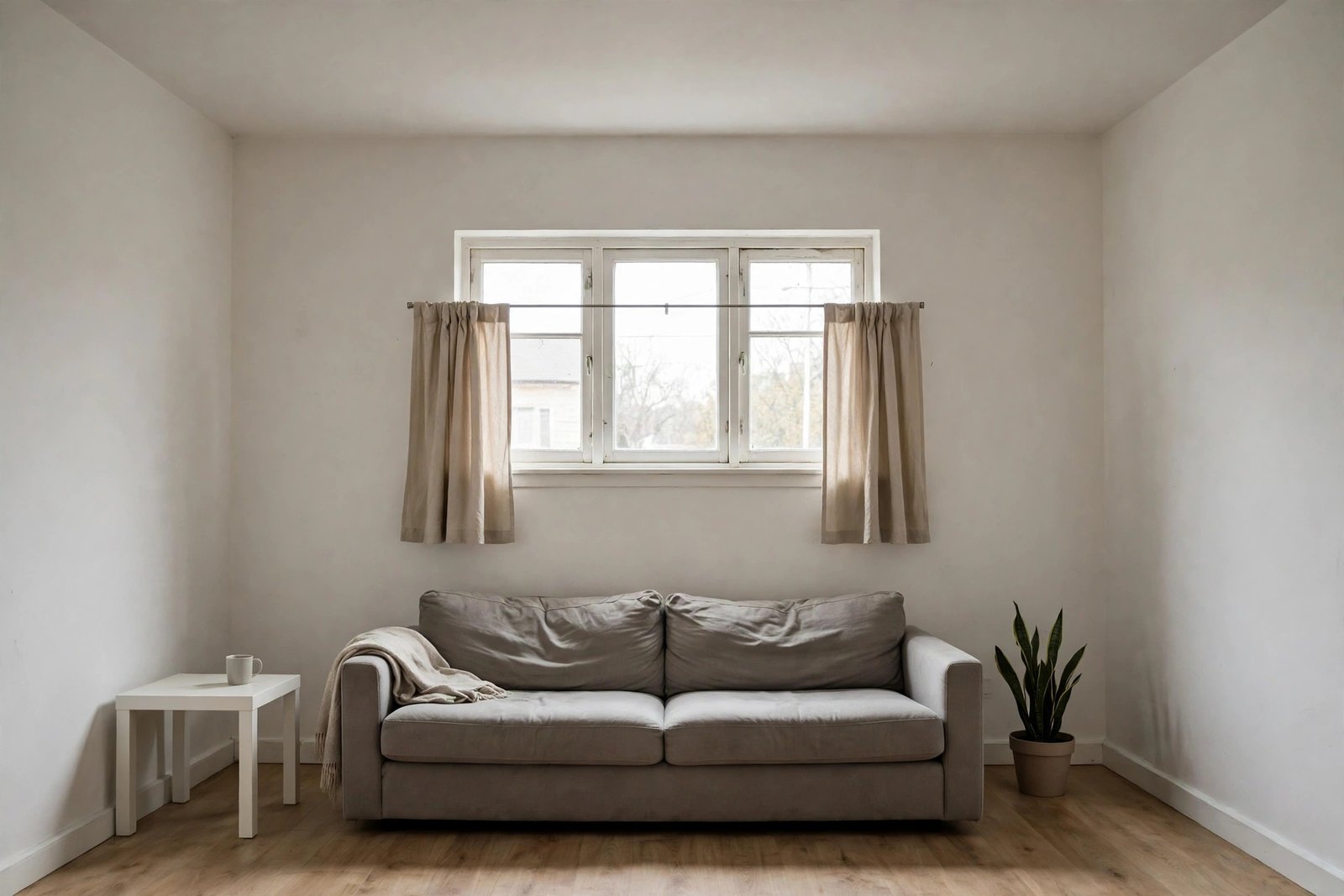
The rod sits on or just above the frame, shrinking the window and the wall. The fix: remount 4–6 inches higher, or halfway to the ceiling. Ten minutes with a drill, a completely different room.
Mistake 2: Choosing a rod that is too narrow
Panels bunched over the glass block light and frame the window like a postage stamp. The fix: a rod that extends 8–12 inches past the frame on each side, so open panels rest on the wall, not the window.
Mistake 3: Buying curtains that are too short
Panels hovering several inches above the floor are the most common curtain mistake of all — usually the result of measuring from the frame instead of from the rod. The fix: measure the drop from the rod’s final height, and size up if you are between lengths. You can hem long curtains; you cannot stretch short ones.
Mistake 4: Mounting the rod too close to the wall
Brackets with too little projection squash the folds against the glass and make panels drag on the sill or radiator. The fix: choose brackets with 3 to 5 inches of projection so the fabric hangs in clean, free folds.
Mistake 5: Using the same length in every room
Sill-length panels in the living room, floor-length panels dangling over a kitchen radiator — one length everywhere ignores how each room actually works. The fix: floor length for living rooms and bedrooms, sill or apron length where heat, water or little hands are involved. The same room-by-room thinking applies on the floor — see our guide to choosing the right rug size.
Quick-Reference Measurements Table
| Measurement | The Rule | Why It Works |
|---|---|---|
| Rod height | 4–6 in above the frame, or halfway to the ceiling | Makes walls and windows look taller |
| Rod width | 8–12 in beyond the frame on each side | Open panels clear the glass; window looks wider |
| Total rod length | Window width + 16–24 in | Room for panels to stack back on the wall |
| Panel length (floor kiss) | Rod height to floor, minus ½ in | Clean, tailored finish that is easy to clean under |
| Panel length (puddle) | Floor length + 1–3 in | Soft, romantic break for linen or velvet |
| Panel fullness | Combined panel width = 1.5–2× rod width | Full, even folds instead of flat, stretched fabric |
| Bracket projection | 3–5 in from the wall | Folds hang freely, clear of sills and radiators |
Frequently Asked Questions
Should curtains touch the floor or hover?
They should just touch it — the “floor kiss.” Ending about half an inch above the floor keeps the line clean and the hems out of the dust. Hovering 2 to 4 inches above the floor is the one finish that always looks like a measuring mistake.
How high should I hang curtains with an 8-foot ceiling?
Mount the rod 4 to 6 inches above the window frame — with a standard 8-foot ceiling that is usually also about halfway between the frame and the ceiling. That placement gives you the maximum height illusion without crowding the ceiling line.
Can I hang curtains from the ceiling instead?
Yes — a ceiling-mounted track is a great option for very tall windows, sliding doors, or walls where the frame nearly touches the ceiling. Just measure the panels from the ceiling down, and choose a track rated for your fabric’s weight.
How High to Hang Curtains: The 10-Second Recap
High, wide, and to the floor. Rod 4–6 inches above the frame (or halfway to the ceiling), 8–12 inches wider than the window on each side, panels that kiss the floor. Follow those three numbers and your windows will look bigger, your ceilings taller, and your curtains like a designer hung them.
Once they are up, styling them takes two minutes: smooth the folds so they fall in even waves, and tie panels back during the day to let the light in. In the festive season we love using velvet bows as tiebacks — the same bows from our mantel styling do double duty here, and you will find them in our shop.
Go raise those rods — and when you are ready for the next project, our room guides are waiting.
Happy decorating!